Showing posts with label Track. Show all posts

Wednesday 12th October 2022

Worklist:
Set up 6 board layout and play trains.
Discuss and issues and develop answers.

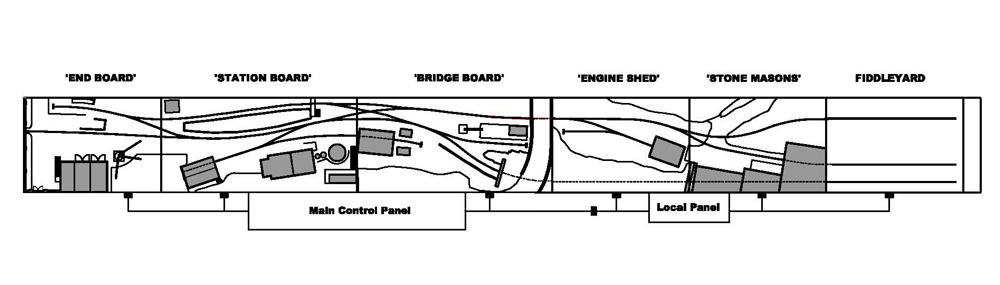
It was good to have Laurence back with us this week. He'd digested last weeks post and now watched  Geoff and Stephen put the layout up for another 6 board running session.


After a quick track-clean, everyone put some stock on the layout and Laurence had some basic training on the Masons control panel. There are no track lines or labels on switches yet, and the just-visible pencil lines weren't much help, but it eased him into some operating. He and Geoff then operated both ends of the layout - it felt just like old Cottesmore West days.

Stephen had been working on the cottages at home and wanted to check the required height of the rainwater downpipes. Afterwards, he started to introduce some of the other mocked-up card buildings, as a reminder of how the buildings had progressed, but also to check visibility of the track/operating areas from behind.


Suddenly, the servos started playing up. Something was wrong, but no obvious reason or solution was forthcoming. Geoff got the programming module out and after some abortive tweaks, settled for reprogramming the 7 servo units (3 points + 4 magnets). Once complete, it was back to operating, but better than ever.

After a while, Geoff described to Laurence the idea of a new section on WC to allow Masons trains to be run right up to the signal on WC, by the Masons operator. Discussions ensued on how track breaks, wiring mods and an additional switch could be undertaken. We then discussed the possibility of having a similar section on the quarry line, which would make sense, but would require a bit more work. All would be investigated in due course.

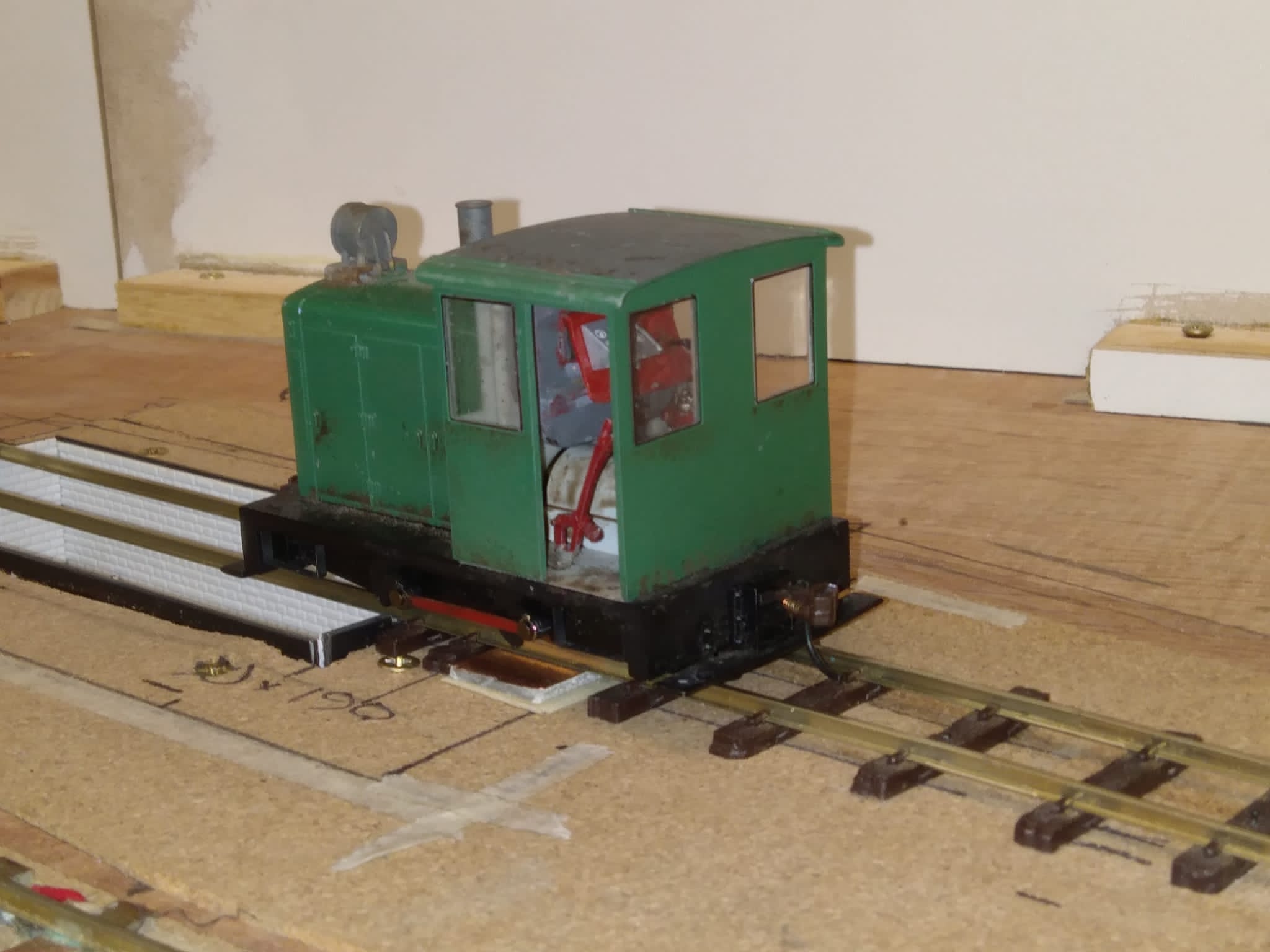
Whilst shunting in Masons yard, a short circuit was encountered. It turned out that a parked wagon wheel was across the track break in the yard while the WC and Masons operators had control of the adjacent tracks. This was more than a nuisance and Geoff suggested that the section should be taken back to the board joint, where wagons were unlikely to be left. However, there must have been a reason for the position chosen, but as neither Geoff or Stephen could remember why, the joint will be 'moved'.




A great day and, hopefully, we'll have another running session next week...


Wednesday 21st September 2022

Worklist:
Check newly ballasted points are free to move.
Ballast areas around tie bars.
Experiment with new roadway mixture.
Fit new edge profile to transition board.
Glue foam for landscaping on transition board.
Discuss control panel fixings.
Discuss testing of full exhibition layout in a straight line!

The blades on the three points were teased back into working order following ballasting last week. Geoff then carefully applied ballast around the tie bars. The track will be over-sprayed to homogenise the ballast colour and add some oil and dirt.


Stephen was still concerned about the masons yard roadway finish. On the main station board, chinchilla dust had been glued with PVA onto the plaster road base, which was smooth. The masons yard road crossings had been created with different height rails to ensure that the running rails could be cleaned without scraping the road check rails and infill. However, gluing the dust between the checkrails had been attempted twice, with poor results, and the lumps could not be reduced in height without removing the dust/texture. Stephen removed the 'lumps' and decided to excavate the plaster a bit deeper, then apply a mix of fine plaster with the dust mixed in. This should allow the height to be reduced without losing the texture, but an inspection next week will show if it works.


Some more of the white faced 6mm MDF was unearthed, cut to shape and glued into place along the board edge. Foam blocks were prepared and glued into place. These will be shaped when set.


An extensive discussion took place on how to fix the local control panel to the baseboard. One key aspect to be considered was the fact that the control panel needs to be fitted on both sides. Schemes included tubes and pipe brackets, end angle plates like the main panel and the like. No decision was made, but the discussion confirmed the need to test the new boards thoroughly, in order to determine position and height. This led to another discussion - could we test the straight exhibition configuration in the workshop? The total length was 2 x 1140mm + 4 x 800mm = 5480mm. Stretching a tape measure to 5.5m led initially to a diagonal arrangement, with Worton Court supported over Geoff's workbench on two short legs and the fiddleyard diagonally positioned in the doorway through to the front garage. This would require an extra trestle to be made - just a simple pair of non-free standing legs. Slight variations in direction edged the layout around until the layout was almost exactly in its usual position, with one end on the storage unit shelf, and no extra trestles required!!!


Although eager to test it out asap, we will complete the basic scenic work and clean up the yard area track first and hopefully have a go in a fortnight?


Wednesday 15th December 2021

Worklist:
Check rails for yard road surface retension.
Engine shed pit edging.
Scenery sub-structure.

Laurence on family duties this week.

Geoff finished off the check rails in the mason's yard to contain the road surfaces and only had a few short sections of the 'repurposed' rail left over. It looked great.


Stephen used prepared strips of 2mm plastikard to reinforce the edges of the engine shed pit. 


Attention then turned to the foam blocks that will eventually become the sub-structure of the hills. Pieces cut up and shaped during the previous exercise and dismantled to work on the underside of the layout were slowly repositioned. Anything that looked ok was glued down with PVA glue. The bandsaw made quick and clean work of shaping some pieces.


We had to stop when the numerous lumps of metal to hold the foam down got in the way. There's always next week.


The paper building models were loosely placed on the foam structure and generally worked well, especially on the section extending out to the engine shed siding where the cottages and winding footpath could now be envisaged much better.
 

Wednesday 8th December 2021

Worklist:
Refit engine shed point servo, point actuator and section wiring.

Just Laurence and Geoff as Stephen not too well, but there was no slacking. The layout was cleared of loose items and the boards clamped vertically to give easy access underneath. The realignment of the engine shed road meant moving the point and so refitting the servo meant a new hole for the activation wire. Once complete, the point, new track section and the inspection pit rails were all satisfactorily tested.


Worklist:
Continue on from last week.....

Well, that was the plan, but Stephen had taken one of Geoff's books on railways in quarries home the previous week and had found a photo that inspired him on two fronts.


Firstly, the projecting corrugated iron clad building could be incorporated into the scene, straddling the track as it enters the masons main building? Secondly, the roadway with check rails and lorries, was exactly as envisaged for the masons yard. 

Due to car problems, Laurence was a little late, so he found Geoff and Stephen deep into a discussion about how to recreate the scene. Working around the Peco plastic sleepers and oversized spikes was the issue. Thin plastic strip - flimsy and fiddly. Code 100 upright - trial notches were cut in the base of a short strip to avoid the spikes, but it became higher than the track rails due to wood-grain. This was to be avoided as it could prevent cleaning of the running rails or if level, whilst the running rails needed to be clean, the check rails really needed to be dirty - a height difference was needed. Code 100 on its side soldered to paxolin sleepers - nope. Code 70 flat-bottom - too fine. We needed chunky flat-bottom rail just under code 100. Geoff started rummaging and found the box he wanted. It was the remains of a large quantity of track sections with plastic ballast bases, bought for 50p. We were aware of code 83 rail, but this was 89/90 thou high. It was perfect, but there wasn't much and it was in lengths of 50-200mm. It was all stripped from the bases and the bottoms cleaned, ready for soldering. Geoff marked the sleeper spike positions and ground a section of the rail away to suit. Paxolin sleepers were packed in alternate gaps and the check rain soldered in place. It looked great.


We also discussed the guarding of the crossing, yard and roadways. Geoff was able to describe the probable requirements - no crossing gates, minimal yard enclosure/fencing etc. The area could be maintained fairly open, which was ideal.

Stephen drifted over to the engine shed and, after forming the section break at the doorway, fixed the rails spanning the inspection pit. A quick check in the control panel and under-board wiring strip confirmed the electrical connection to the shed section had still to be fitted, which it was.


The rails are stiff enough to support a model train, so would be operational for running sessions. Edgings, columns, bracing etc will be fitted in due course.

A long discussion ensued regarding the cottages. Stephen was concerned about the size of the paper mock-ups he'd produced previously in comparison to the industrial buildings. He'd drawn-up a new cottage from the booklet - 'Welsh Industrial Workers Housing 1775-1875'. This was smaller, with smaller windows, and the reduced details made the appearance much better. Q - were we looking at the front or rear of the cottages? The space between the engine shed and cottages was restricted, maybe not suitable for front doors? Furthermore, the path would be minimal, and would end up down in the stone yard. Geoff was adamant that the buildings drawn, although 'Fronts', were similar to the backs of some he'd seen alongside a North Wales NG railway line (with the addition of some kitchen plumbing!). Regarding the path, he explained that it would be quite normal for such a path to meander through a railway yard. The bottom dwelling could even be a larger managers house. It all sounded feasible.


Wednesday 6th October 2021

Stephen and Laurence had forgotten that a pub lunch had been agreed the previous week and they had brought their sandwiches. As the table was booked and Geoff was already thinking about what he would have, we decided to have a short session in the workshop before and after lunch. 

We decided to get a minimum of boards out and have a think about the scenery on the two full scenic boards - the engine shed and the mason's yard. First of all, a mock-up of the quarry track cover (a tunnel with an open side at the back) was created. This will probably be 6/9mm plywood with fillets. If reinforced suitably, it could be cantilevered, or a few small pillars introduced.


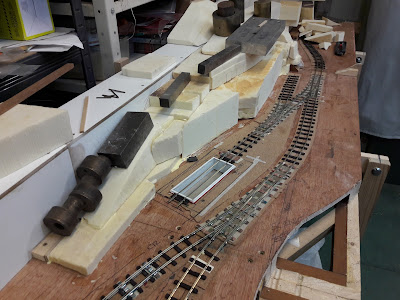
After a hunt around the workshop, some of the original cardboard mock-up pieces were found. The main building with the siding and the 'spoil-heap bridge' were dropped into place as were card squares indicating where the other mason building fronts would go. Boxes with thin cork off-cuts laid over them were initially used to get a feel for the hills, but screwed-up newspaper balls made a better job. A box was used for the engine shed to assess ground level issues around it. The central area where a row of workman's cottages had been discussed some 18 months previously caused the most trouble. These would fill in the backdrop, but also form the transition between the works buildings ground level and the much higher hillside profile at the bridge. Various arrangements of cottages and terrain were considered, but it was decided that research would be undertaken and paper/card cottages produced that could be moved around (and up and down) to find a final solution.


The quarry tunnel (left) and the siding entering the main mason's building en-route to the fiddleyard. We briefly discussed how much detailing would be required to disguise the sight of the quarry traffic, but decided it was something to consider later.


Wednesday 29th September 2021

Worklist:
Get the exchange area control system working.

A full house and all focus was on working out what is wrong with Stephens control/switching system for the exchange area. The whole layout (minus fiddleyard) was set up to provide a testing area beyond the exchange boards. Moving on from last week, Geoff had a plan to test what route power was taking through the control box. He quickly identified that two section wires were reversed. After swapping within the box, we had switchable power on the outer (Quarry) line. Another short while later another reversed pair were found and corrected. We suddenly had a a fully working system. After the wiring changes were recorded, we spent a fair time testing the system. 

Local Panel - Using the track section switches on board 1 to isolate trains driven onto the exchange area (boards 2 & 3). Main Panel - used the two-way switch box to take control of the exchange area and drive the train into Worton Court. Ditto from Main panel to Local panel. Ditto mainline track.

Local Panel switched Quarry overall power selector switch to Main Panel. Main Panel drives train from Worton Court through to 'Fiddleyard'.

Laurence had to run through the different options a few times to grasp the concepts, but was confident that a good practice session would fix the systems.


All early testing was with one controller/panel. The AMR controller that was bought 'untested' on eBay then had the plug exchanged to match our standard socket, but was initially wired up wrong. When examined closely, the unit had failed along a PCB track that was almost completely corroded away. A quick addition of a soldered jumper and we were back in business with two controllers.

Finally, Geoff got his wonderful machine out and the two black boxes were labelled.


It was very satisfactory to finally have a fully functional electrical system!


Wednesday 8th September

Worklist:
Test the new control panel and loom on the layout.

The start time was set back due to a combination of the weather, tea and some lovely homemade rhubarb cake, but we eventually made it into the workshop.

The full 10 board layout was set up (we're getting quicker). The new hand held controller plug hadn't arrived, so control was provided by using the main panel unit. The exchange board wiring 'spider' had temporarily been 'lashed' together to power the 4 adapter boards from the new control panel. Laurence's Deceauville was run from the fiddle yard around to the bridge on the mainline, then switched over and run back on the quarry line. However, the Mason's board quarry section was was dead, so investigations were undertaken. A mis-placed wire in the panel was found and correctly connected. Stephen continued to test the tracks and points, with all sections traversed several times. Meanwhile, Geoff examined and rectified some areas of track that appeared to be under gauge and some adapter board joints that were slightly out of alignment. Early on in the session, one of the section switches LED's had flickered and failed although power to the track was ok. The switch was successfully replaced.


Next week we intend to look at finishing the track. A short section in the engine shed is required, but this is over a full inspection pit, The siding off the engine shed will have a simpler ash pit added. Both require holes through the baseboard, so their designs need to be carefully established.